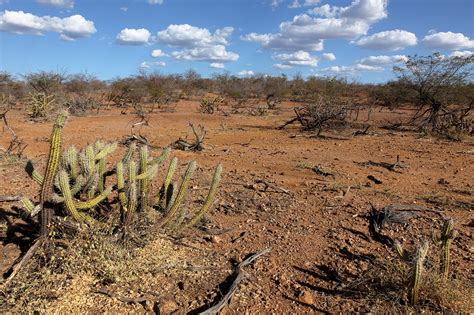
Caatinga (Portuguese pronunciation: [kaaˈtʃĩɡɐ]) is a type of semi-arid tropical vegetation, and an ecoregion characterized by this vegetation in interior northeastern Brazil. The name "Caatinga" comes from the Tupi word ka'atinga, meaning "white forest" or "white vegetation" (ka'a = forest, vegetation, tinga = white). The name "Caatinga" is a Tupi word meaning "white forest" or "white vegetation" (caa = forest, vegetation, tinga = white). Caatinga is a xeric shrubland and thorn forest, which consists primarily of small, thorny trees that shed their leaves seasonally. Cacti, thick-stemmed plants, thorny brush, and arid-adapted grasses make up the ground layer.
Caatinga geografische betekenis De caatinga is een uniek en divers ecosysteem dat we alleen in de noordwestelijke regio van het land kunnen zien. Het strekt zich uit door de staten van Alagoas, Bahia, Ceará, Maranhao, Paraíba, Pernambuco, Piauí, Rio Grande do Norte en Sergipe.
Caatinga definitie
Caatinga (Portuguese pronunciation: [kaaˈtʃĩɡɐ]) is a type of semi-arid tropical vegetation, and an ecoregion characterized by this vegetation in interior northeastern Brazil. The name "Caatinga" comes from the Tupi word ka'atinga, meaning "white forest" or "white vegetation" (ka'a = forest, vegetation, tinga = white). The meaning of CAATINGA is stunted rather sparse forest that is leafless in the dry season and is widespread in areas of small rainfall in northeastern Brazil.
Caatinga definitie Caatinga is a xeric shrubland and thorn forest, which consists primarily of small, thorny trees that shed their leaves seasonally. Cacti, thick-stemmed plants, thorny brush, and arid-adapted grasses make up the ground layer.
Caatinga klimaat
Caatinga is an important area of endemism for different groups of organisms, harboring a unique biota with thousands of endemic species. The biodiversity of Caatinga is made up of at least 1, species of vascular plants, at least fish species, 44 lizards, nine amphibians, 47 snakes, four turtles, three crocodiles, 49 amphibians, birds. Caatinga (Portuguese pronunciation: [kaaˈtʃĩɡɐ]) is a type of semi-arid tropical vegetation, and an ecoregion characterized by this vegetation in interior northeastern Brazil. The name "Caatinga" comes from the Tupi word ka'atinga, meaning "white forest" or "white vegetation" (ka'a = forest, vegetation, tinga = white).
Caatinga klimaat The current climate of Caatinga features average monthly temperatures ranging from highs of 34°C during the day to lows of 27°C. The average yearly temperature is around 31°C. At night, temperatures in the colder months average around 18°C and in the warmer months around 23°C.
Caatinga brazilie
The Caatinga covers the interior portion of northeastern Brazil bordering the Atlantic seaboard (save for a fringe of Atlantic Forest), extending across nine states: Piauí, Ceará, Rio Grande do Norte, Paraíba, Pernambuco, Alagoas, Sergipe, Bahia, and parts of Minas Gerais. The Caatinga, Brazil’s natural treasure, holds incredible secrets that reflect its unique biodiversity and importance to the ecosystem. In this article, we dive into 25 fascinating facts about the Caatinga, connecting you with this amazing biome.
Caatinga brazilie The most ruralized biome in the country occupies an area of approximately km², which corresponds to about 70% of the Northeast region and 11% of the national territory. It is exclusively Brazilian, and the name “Caatinga”, of Tupi-Guarani origin, means “white forest”.
Caatinga ecosysteem
Most of the Caatinga has a semi-arid climate, consisting of average temperatures ranging between 24° and 30 °C and low precipitation rates, which oscillate as a result of location and synoptic-scale atmospheric phenomena: Intertropical Convergence Zone (ITCZ), Eastern Wave disturbances, and anomalies in the Atlantic and Pacific Ocean Surface Temperatures (SST) (Silva et al. ; Ferreira et. Caatinga (Portuguese pronunciation: [kaaˈtʃĩɡɐ]) is a type of semi-arid tropical vegetation, and an ecoregion characterized by this vegetation in interior northeastern Brazil. The name "Caatinga" comes from the Tupi word ka'atinga, meaning "white forest" or "white vegetation" (ka'a = forest, vegetation, tinga = white).
Caatinga ecosysteem The Caatinga has long been home to human populations, with Indigenous groups and traditional communities developing land-use practices suited to the region. Historically, subsistence agriculture and small-scale livestock grazing dominated, relying on drought-tolerant crops such as cassava and careful vegetation management.